
Wedge Technology
Let’s work together

 Our Technology
Wedge Technology
We design next-generation wave energy converters (WEC) for specialized applications such as ocean observation, offshore aquaculture, and remote power backup.
For instance, our FLORA ocean station systems enable remote-controlled, in-situ observations of marine life in inaccessible or harsh offshore environments.
This innovative solution combines our advanced WEC technology with cutting-edge sensors, making offshore measurement campaigns possible where they were previously unattainable.
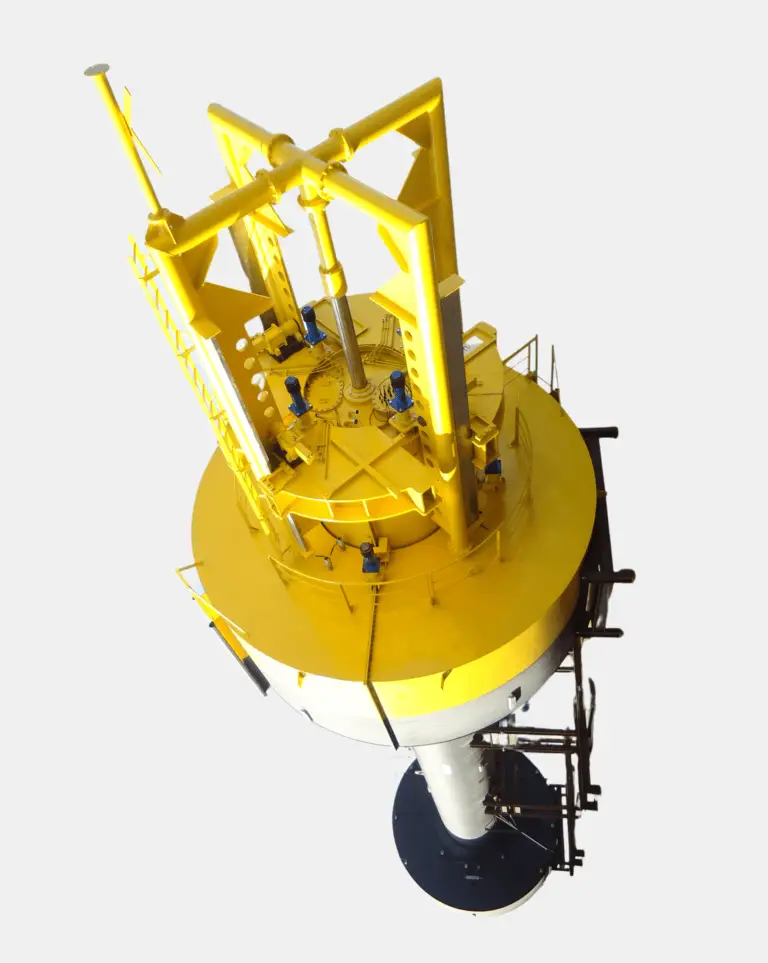
Our point absorber – a type of WEC – is designed to harness the vertical motion of sea waves. The system consists mainly of a combined ring-like ‘floater’ and a tube-like ‘spar’ that rests on the surface of the sea and is anchored to the seabed. As waves pass, the floater rides up and down spar.
This relative motion between the floater and the spar drives an internal power take off (PTO) – a linear electromechanical generator which generates electricity. Point absorbers are particularly versatile because they can capture energy from waves coming from all directions and are effective in a wide range of wave conditions. Their design allows for scalability and deployment in deep or shallow waters.
The efficiency of our patented (200kw – 400kw) PTO in converting wave energy into electricity has made it one of the most promising technologies in the field of wave energy, with ongoing research and development aimed at improving its cost-effectiveness, durability and manufacturability.
Over the decades we’ve had to continually question design problem(s) and constantly iterate, learn and optimize our product engineering to achieve system optimality. Through several R&D projects we’ve improved our technology in sub-areas of, inter alia, power-take-off, transmission, electrical and energy engineering, naval design and station keeping. In so doing we have achieved a high technology readiness level (TRL) of 8.

Our Technology
Wave energy and point absorbers
The fascination with wave energy is as timeless and profound as the sea itself. From ancient civilizations using simple mills, harnessing the rhythmic waves of the sea, to the inventors of the 18th and 19th centuries dreaming up the first concepts of wave energy devices, the journey of ocean energy has been one of passion, persistence, and innovation.
In the modern era, this quest has crystallized into the development of sophisticated technologies designed to capture the ocean’s wave energy more efficiently and sustainably than ever before. Among these, the point absorber methodology stands as a prevailing concept.
Point absorbers, buoy-like structures that float on the water’s surface and move with the waves, embody the elegance of simplicity and the promise of harmony with nature. They capture the kinetic energy of waves from all directions, converting it into electricity with a grace that belies the complexity of their internal mechanisms.
The compelling case for point absorber technologies as a viable commercial offering is underscored by a combination of technological advancements, environmental imperatives, and the sheer magnitude of the resource itself.
Recent studies estimate that the global potential for wave energy could be in the range of 2 TW (terawatts), highlighting not just an abundant source of clean energy, but one that is significantly untapped. The advancements in wave energy technologies, particularly in point absorber systems, have demonstrated increased efficiency and durability, with prototypes achieving energy conversion efficiencies upwards of 15-20% under real-world conditions. Moreover, the cost of wave energy driven electricity is projected to decrease significantly as technologies mature and scale up, with the levelized cost of electricity (LCOE) expected to become competitive with other renewable energy sources within the next decade.
Wave energy offers unique advantages over other renewables, such as higher predictability and consistency due to the vast, untapped energy present in ocean waves that is not subject to the same temporal variability as solar or wind energy. This reliability can significantly enhance the stability and security of remote or renewable energy grids. Coupled with global initiatives aimed at decarbonizing energy systems, wave energy, and point absorbers, in particular, are not only technologically ready but are becoming economically attractive
